As we mature processes, they come within reach of actual automation. Especially IT management processes. To paraphrase General Carl von Clausewitz, who said “War is the continuation of diplomacy with different means”, we can say that automation is the progression of process maturity with different means - replacing human effort with software and systems.
My favorite historical example is IP address allocation. In the past, whenever there was a new computer, you would walk up to the head of the lab or data center and ask for a new IP address for that machine. They’d pull out their notebook, sharpen their pencil, and note your address down. Simple, manual, and not built for scale. You may remember that.
Here is the conversation, written in the language of promise theory.
Q: Can I get a unique IP address? R: Here is your address, let me know when you are done with it (some time passes) A: thank you, I am done with this address
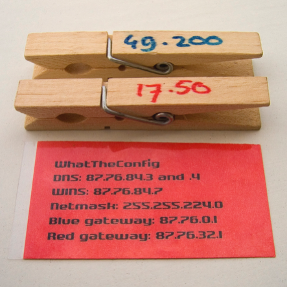
Self-service versions of this have been in use at hacker camps, as the picture illustrates.
Instead of asking for an address, the set of clothespins is an implicit offer.
The official standard for this was RFC2322, published April 1, 1998 (who said hackers don’t have humor?).
In 1994 I went to a Unix systems administration conference and they had Mike O’Dell over from the USA. He had a presentation about the internet where he talked about many layers of technology to just push IP packets around. I was impressed by the number of layers back then, but I think what he was trying to say was how wasteful it really was, and that many of these things had to be re-engineered to allow the internet to grow.
As a side note, the internet grew by a factor of 500-1000 in number of users in the following thirty years. At the time of the conference there were a few thousand websites worldwide, and this conference is the first one listed on the NLUUG website.
We talked with Mike in the bar afterwards, where he said: “You know, next year Microsoft’s going to come out with a new version of Windows (editor note: Windows 95) and that will have an internet protocol stack built in to the operating system. They’re planning to sell 150,000 of those every month”. That sounded like a staggering amount to me at the time. And it got me thinking. Can you imagine how many IP addresses that will be right? How are we going to manage these? We need more pencils!
Then he mentioned that Microsoft collaborated with the IETF to define an automated system for IP address allocation. That standard we now know as DHCP, and it is also in every PC and practically every network. It very likely has reduced many errors that happened in the traditional process, such as duplicate IP addresses being handed out.
The following diagram shows the flow of messages, each of which can be rephrased in promise theory terms.
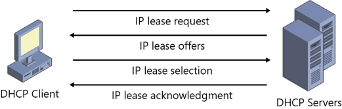
For example, the first message from the diagram goes something like this:
Please promise to give me a lease on an IP address that you don’t give to somebody else.
The RFC2131 specification can be read as an extensive set of (conditional) promises, covering a variety of scenarios as they have played out in the real world. For example, what happens if the lease is never returned, or when the server runs out of addresses.
What we see here is that a process (address allocation) matured enough for it to be automated. Consequently, it can scale up, and it can be of higher quality. And an interesting note is that promise theory allows us to describe both the manual and the automated process, which makes it easier to discuss the transition.
Another perspective on this is that this activity largely fades into the background of the system administration domain, and becomes part of the technical digital infrastructure. This is a very common pattern in IT, systems administration, and in digital infrastructures in particular.
Compare how assemblers and compilers were heralded in the early days of writing software as making programmers redundant. Well, automation did not make them redundant, it just made them write software on a much higher level of abstraction, leading to more productivity and more quality.
The same thing happens in systems administration: as parts get automated, admins operate at a higher level. Research supports this. In the late eighties, a university colleague of mine, now a retired professor, was doing his PhD on network management architectures—a concept that was quite elusive at the time. What did network management entail? How would it be standardized? Back then, the idea of computer networks was still new, and automating their management seemed unnecessary because there were so few computers. However, once networks started to scale, network management became much more critical.
His research focused on SNMP and similar technologies. Just as DHCP automated address allocation, SNMP helped manage network measurements and settings. Ultimately though, he concluded that network management encompasses everything not yet automated into a protocol. Again, this represents a maturity story: human management handles what we cannot automate (yet).
That is the cycle of digital development: from manual effort to mature processes to automation—and then on to the next layer of complexity.